
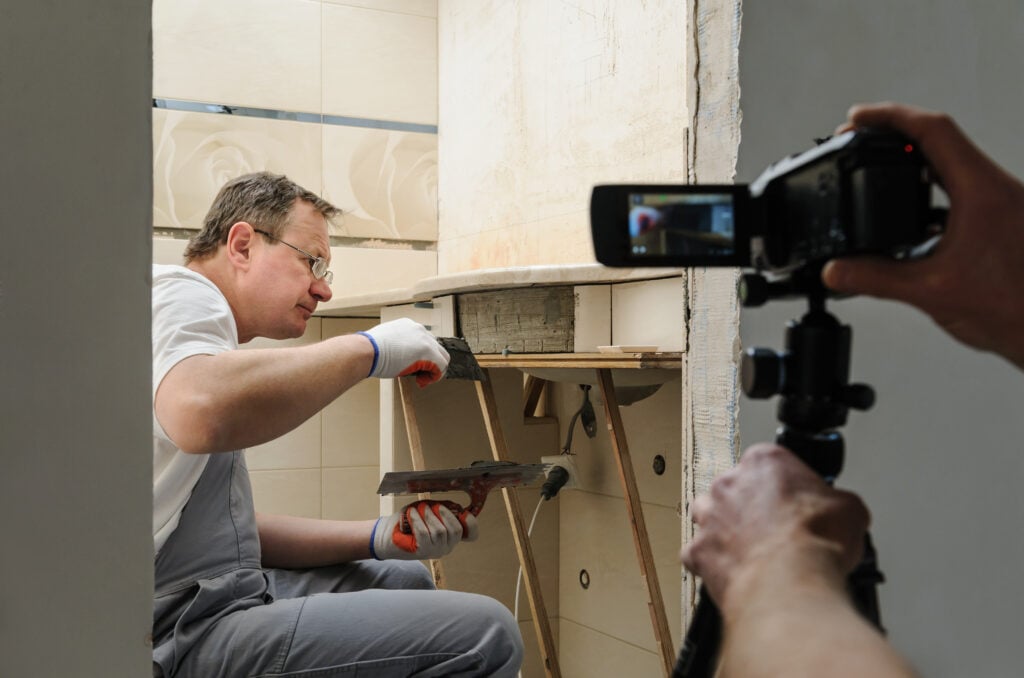
Homeowners don’t want a commercial. They want to see the work, hear how you think about the price, and get a sense of who will be at the door. That is a much smaller job than most contractors imagine.
Contractor video marketing comes down to three kinds of video, all filmed on a phone at jobs you were already doing: a walk-through, a price explainer and a short clip of your people. No videographer, no script, no need to become a “personality.” The rest of this article covers why those three, how to shoot each, and where to put them.
What staying off video costs a contractor
Someone with a stain spreading across the bedroom ceiling rarely calls the first roofer they find. They look at three or four, read reviews, click through websites and scroll a Facebook page. They are trying to work out whether you do this kind of job, whether the finished work looks good, and whether you seem like people they’d be comfortable having in the house.
Photos and reviews answer part of that. Video answers more of it in less time, because the homeowner hears you explain the problem and sees the result. According to Wyzowl’s Video Marketing Statistics 2026, 85% of people say they’ve been convinced to buy a product or service by watching a video, and 63% say a short video is how they’d most like to learn about one.
Two caveats. Wyzowl is a video production company, and its survey covered marketers and consumers across all kinds of products, not homeowners choosing a roofer. We read it as support for something we see ourselves: people check a business out before they get in touch, and a short video is an easy thing to check.
So the cost of staying off video shows up at one moment, when someone is choosing between you and two other companies. If one of them has a few dozen clips of finished jobs and your page has a logo and a post from two years ago, the homeowner knows more about them than about you.
Contractor video marketing: the three videos
Video 1: The job walk-through
It’s evidence. A review says you did good work, and the walk-through shows it. It also answers a question many people never ask out loud: what will my house look like when these people leave?
Say you paint exteriors in Skippack. On day one, stand at the end of the driveway and film ten seconds of the “before,” saying what you see: peeling on the south side, bare wood under the eaves. On the last day, stand in the same spot and film the finished house, the ladders gone and the drop cloths folded. Hold the phone upright, walk slowly, and talk as if the homeowner were beside you. Ask permission first, of course.
Is your footage good enough? Almost certainly. A slightly shaky clip of your own job tells a homeowner more than a smooth one that could belong to anyone.
Video 2: The “what this costs and why” explainer
Every trade has a conversation that keeps coming around. For an electrician it’s why a panel upgrade costs what it does. For an HVAC company it’s why you can’t just recharge the refrigerant. For a plumber it’s why an installed water heater costs more than the one on the shelf at the home store.
Price is one of the things a homeowner most wants to understand before calling, and one of the hardest to find out. We often hear the worry that talking price on camera will scare people off. It may put off a few. The person who does call has already seen what’s involved, so the first conversation starts further along.
Whether to say actual numbers depends. Sometimes a range you’re comfortable with helps the right customers recognize themselves. Sometimes prices swing so much from house to house that a range would mislead, and explaining what drives the cost is more useful. Stand beside the panel or the furnace, say the question aloud, and answer it in plain language in thirty to sixty seconds. If you stumble, keep going.
Video 3: Who shows up at your house
Homeowners hire people more than they hire a company name, and letting a stranger in is part of the hesitation behind any home service call. A homeowner who has watched your lead tile setter explain how he checks a shower pan already feels they know a little about who is coming.
Picture a bathroom remodeler in Allentown whose lead installer has been with the company for twelve years. Before he leaves the shop, the owner asks him one question on camera: what’s the first thing you check before you tile? He answers for thirty seconds. The clip goes up with his first name and how long he’s been there, with no music or title cards. For a contractor, the brand is the crew.
Check with your people first. A reluctant foreman reciting a line helps nobody, and one or two who enjoy talking about their work are enough.
Where to post, how often, and what to skip
The same upright clip can go to Facebook, Instagram Reels, YouTube Shorts, TikTok and your Google Business Profile. Go where your customers already are. In Pew Research Center’s 2025 survey of social media use, 84% of U.S. adults said they use YouTube and 71% said they use Facebook, compared with smaller shares for Instagram and TikTok. That is national data, not a count of homeowners in Bucks and Montgomery County, but it’s a sound reason to put Facebook and YouTube first. Our guide to social media platforms goes through which suit which business.
Your Google Business Profile has tighter limits. Google’s help page on photos and videos lists videos of up to 30 seconds at 720p or higher, and says they appear only once the profile is verified. A before-and-after fits. A sixty-second price explainer needs a shorter cut. If the profile itself needs work, see our guide to Google Business Profile for contractors.
We’d aim for two or three videos a week if you can keep it up, in rotation: walk-through, explainer, people. If you can’t, one a week that you keep will serve you better than ten in a burst followed by months of silence.
Skip trend dances unless that really is your crew’s idea of fun. Skip drone montages with dramatic music, which look impressive and could belong to any company. And skip anything that needs so much editing it never gets posted. Wyzowl reports that the large majority of businesses now use video, so having it won’t set you apart. A recognizable job and a plain explanation will.
What to expect from contractor videos
Video rarely brings in work by itself. Someone still has to find you, through a search, a referral or an ad, and the video helps that person decide to call. So we’d judge it next to the website, the reviews and any advertising, not by view counts.
We’d look for callers who mention something they watched, estimate visits that start further along because the homeowner already understands the price, and more inquiries for the kind of job you filmed. Those signs tend to appear gradually as the library grows. The first few videos will feel awkward and few people will see them. If the real problem is that too few people find you, video is only part of the answer, and our article on how to get more leads as a contractor covers the rest.
What video takes from you
Mostly consistency. Nobody controls how widely a platform shows a clip, and nobody can say a certain number of videos will produce a certain number of jobs. What you control is whether a homeowner who looks you up finds recent work, clear answers and familiar faces.
The footage is your part, because we can’t film a job we weren’t at. In the Wyzowl survey, most respondents said they make their video in house, so filming your own is the usual way. What can be handed off is planning, editing, captions and posting. Our social media management work covers agreed content and publishing, and video help is scoped separately.
Film the “before” on your next job
This week, film ten seconds of the “before” at your next job start, standing where you can stand again on the last day, and set a phone reminder for that day. It costs nothing and takes a few minutes.
If you’d like help planning the rest or keeping it going, tell us what you post now, what keeps getting pushed aside and which jobs you want more of. We’ll say what we’d suggest and what we’d need from you. Your first consultation is free.